Wire Harnessing Solutions for Building Temperature Control in North America: An Application Guide
A building temperature control system is only as reliable as the wire harness connecting its controllers, sensors, valve actuators and power feed. This application guide is written for engineers specifying custom wire harness assemblies for building temperature control projects in Canada and the United States. It covers the operating conditions that decide harness configuration, the compliance documents North American projects ask for, the drawing-to-production route, and the commercial terms involved.
Wire HarnessCustom Harness AssemblyIndoor / OutdoorUL & CSAOEM / ODM
The Problem: One Building, Many Electrical Environments
A zone controller inside a conditioned room, a valve actuator on a hot pipe, a rooftop sensor exposed to rain and freeze-thaw cycles, and the power feed into a control panel all belong to the same temperature control system, but they do not share the same electrical environment. When every run is specified as one generic harness, three problems appear: insulation that hardens where flexibility is required, unshielded signal lines routed beside high-current conductors, and connectors that were never identified by brand and part number.
Under-specified drawings are the most common root cause. A harness drawing that omits the connector brand and part number, the wire type (for example UL1007), the wire gauge (for example 28AWG), the colour of each circuit and the functional definition of each pin cannot be built or verified to a repeatable standard.
Three conditions specific to building temperature control in North America shape harness selection:
- Indoor and outdoor equipment inside one project. Mechanical rooms, rooftops and occupied spaces place waterproof, non-waterproof, indoor and outdoor requirements into a single bill of materials.
- Continuous duty. Temperature control equipment normally runs 24/7, so harnesses must tolerate long duty cycles rather than intermittent use.
- Evidence before release. Buyers in the United States and Canada typically require certification and material compliance documentation before a harness is released to production.
Industry Background: How Harness Supply Reaches North America
Wire harnesses are a global and highly fragmented category. Precedence Research estimates the global wire harness market at USD 99.58 billion in 2024, with Asia Pacific holding a 46% share, supported by electronics and automotive manufacturing in China, India and Japan. Future Market Insights identifies the automotive segment as the dominant end-user segment in 2024 - a reminder that building-control harnesses are engineered by the same supplier base as automotive harnesses, but to different requirements.
On the acceptance side, IPC/WHMA-A-620 is the primary industry-consensus standard for requirements and acceptance of cable and wire harness assemblies, organised into Classes 1, 2 and 3 for different levels of product criticality. Those classes are normally named in the drawing package rather than assumed by the manufacturer.
For trade documentation, HS code 8544.30 covers ignition wiring sets and other wiring sets of a kind used in vehicles, aircraft or ships. Building control harnesses generally fall outside that specific description, so the classification of a given assembly is normally confirmed with a customs broker rather than inferred from the heading.
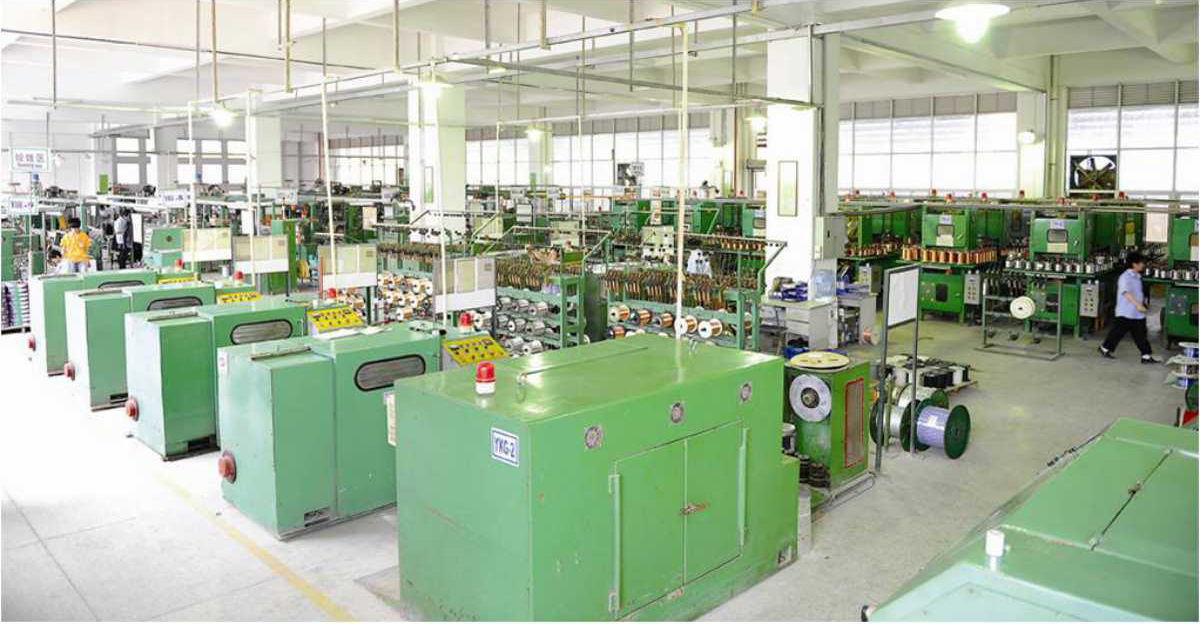
P-Shine Electronics Co., Ltd is a Dongguan-based wire harness and cable assembly manufacturer established in 1997. The company operates 7 independent factories producing wire harnesses, USB cables, cable assemblies, AC power cords, customized connection cables, wires and cables, and reports a 60% export ratio with the European Union, the United States and the Middle East as its main markets. Export markets therefore already include North America, which matters for purchasing engineers because documentation, logistics and drawing conventions are handled in a market-facing way rather than as an exception.
Detailed Solution: A Configurable Harness Architecture
P-Shine Electronics provides both OEM and ODM production services, and all wiring harnesses are customized according to customer drawings. Nothing is delivered as a fixed catalogue model, which means a building temperature control harness is defined by six configuration decisions rather than by a stock part number.
1. Connector definition and sourcing
Connectors are purchased strictly according to the brand and part number stated on the customer drawing, typically through authorised distributors such as DigiKey or Mouser so that the parts received are genuine and original. Series commonly used in control and temperature equipment include Molex, JST, TE, Phoenix, Samtec, Hirose and Amphenol connectors. Original connectors remain the default because reliability and compatibility are better. Where a customer requests it, and where the alternative is treated as a mature product with reliable quality, P-Shine can offer samples of non-original alternative connectors; those parts are used only after the customer has tested, verified and approved them. In some cases the price of an original brand connector can be around ten times that of a non-original alternative, so the decision is a commercial trade-off owned by the buyer rather than the supplier.
2. Conductor and insulation selection for heat
Wire type and gauge are set per circuit, with UL1007 wire and 28AWG gauge as typical examples for low-voltage control runs. Available insulation materials are PVC, XL-PE, TPE, TPU and TEFLON. For runs near valve bodies, boilers or other hot surfaces, high-temperature-resistant constructions in XL-PE or TEFLON are the appropriate choice; PVC remains the general-purpose standard, while TPE and TPU support flexible and exposed routing.
3. Shielding for signal and control lines
Shielding is one of the listed special requirements for these assemblies, and multi-core shielded cable harness construction is used where sensor signals and control module communication must run alongside power conductors. Shielding matters most where a signal line shares a cabinet, trunking or grommet path with a high-current power run - a routine situation in a temperature control panel.
4. Waterproof and outdoor configuration
Waterproof harness construction is a listed option, alongside flame-retardant, low smoke and halogen-free variants. Applicable working conditions for these assemblies cover indoor and outdoor installation, inside and outside equipment, and both waterproof and non-waterproof requirements. That range is what a building project needs when rooftops, plant rooms and occupied spaces appear on the same drawing set.
5. Termination and 100% test
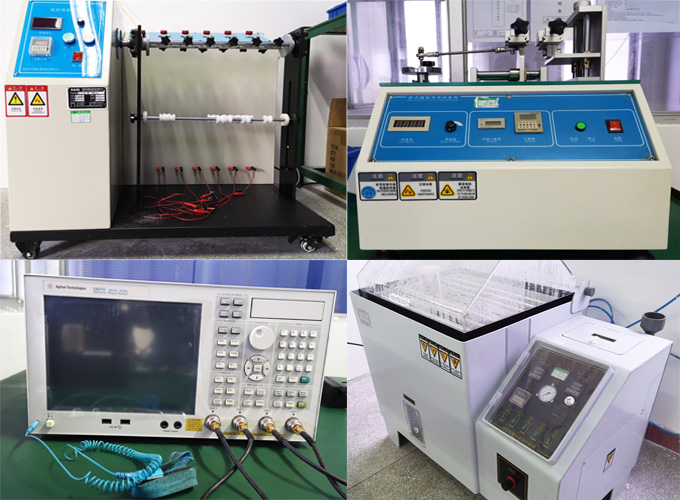
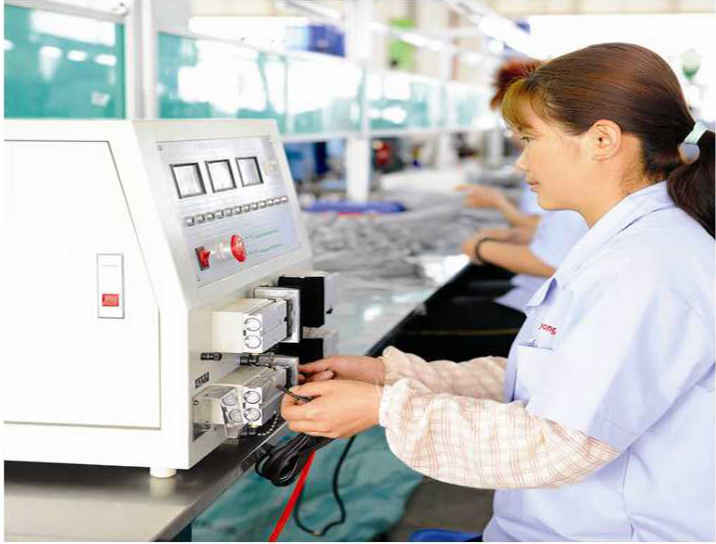
Assemblies are built with terminal-crimped terminations, and every unit is tested - 100% test is the production rule rather than a sampled check. Acceptance can be arranged either as a pre-shipment test or as a test after the goods are received, depending on the buyer's preference.
6. Compliance documentation for the United States and Canada
For North American projects, the relevant first-party evidence is specific and checkable:
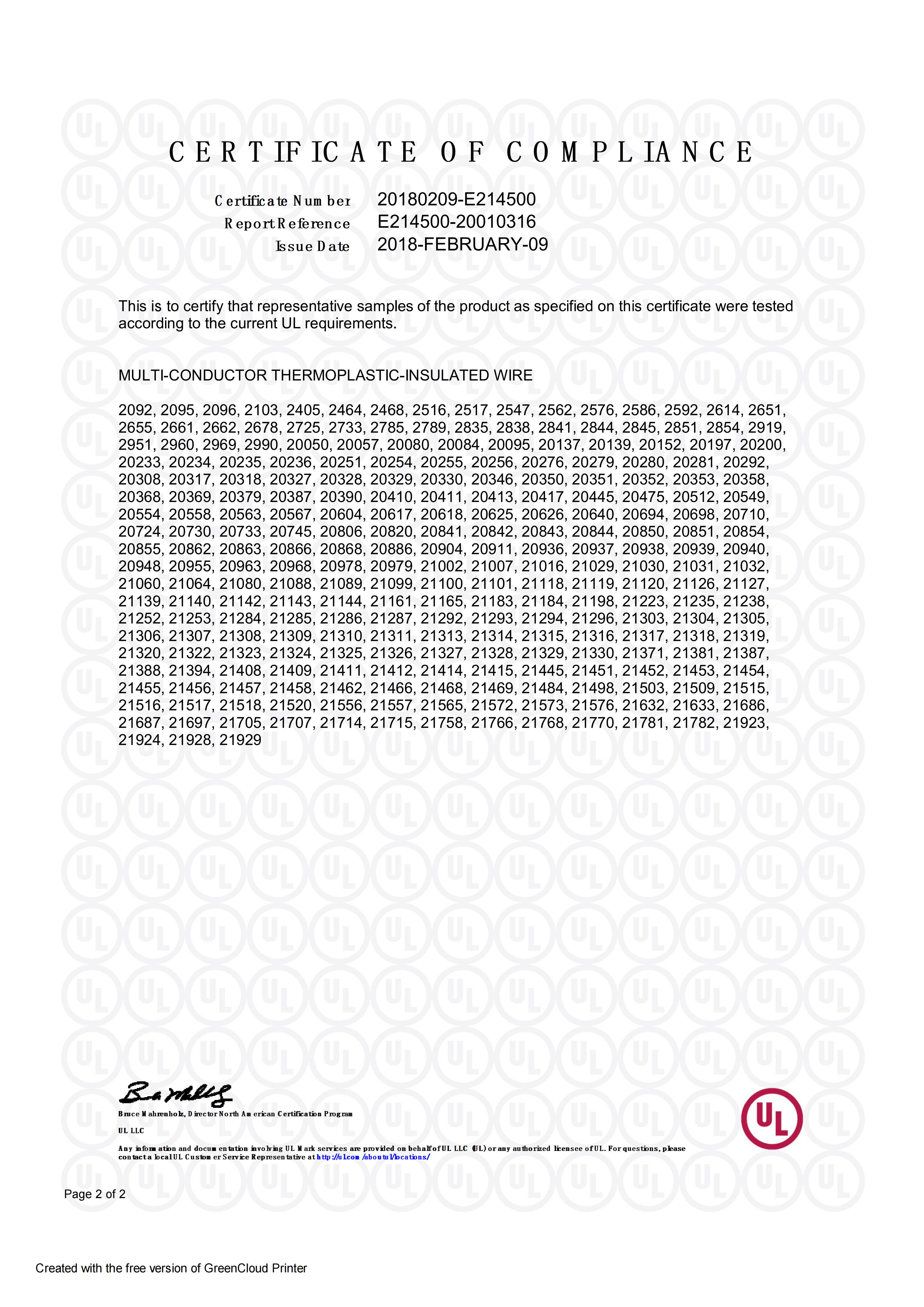
- UL - file E214500, issued by UL LLC for Component-Appliance Wiring Material (single-conductor and multi-conductor thermoplastic / thermosetting-insulated wire), to UL 758 Appliance Wiring Material and CSA C22.2 No. 210-15, covering the USA and Canada markets.
- ISO 9001:2015 - certificate CN07/31354, issued by SGS United Kingdom Ltd, covering manufacture of electronic cables, power cables, flat cables and power plugs.
- ISO 14001:2015 - certificate CN19/30539, issued by SGS United Kingdom Ltd, covering manufacture of electronic connectors and wire harness.
- VDE - certificate 40042054, issued by the VDE Testing and Certification Institute for flexible cables with thermoplastic PVC insulation.
- Materials comply with RoHS, REACH and California Proposition 65.
The UL scope is written at construction level - appliance wiring material under UL 758 and CSA C22.2 No. 210-15 - which is the level North American reviewers examine when a harness uses AWM wire. Engineers should still match the certificate scope to the wire type actually called out on their drawing.
Step-by-Step: From Drawing to Mass Production
Six steps take a building temperature control harness from concept to volume. They mirror the sequence used for complex custom harnesses.
- Define the functions to be implemented. List what the harness must carry: power, ground, sensor signal, control signal, communication.
- Plan circuits and assign each one a function. Fix the number of circuits and define what each circuit does, including Power+ and GND.
- Select suitable connectors. Choose the brand and part number for every interface, including equipment ports, PCB interfaces, signal control modules and power control modules.
- Complete the drawing and simulate it. Produce the drawing and check routing, lengths and branch positions before tooling, cutting or crimping begins.
- Build samples and test them. Sample assemblies are made and tested - this is where connector choice, gauge and branch geometry are confirmed.
- Finalise the design and start mass production. Once approved, the drawing is frozen and volume production starts.
Drawing checklist for temperature control harnesses
A drawing package that carries the following information can be quoted, built and verified without round trips:
- Each connector specifies its brand and part number.
- Where the same connector is used in adjacent locations, different colours differentiate them.
- Each wire in each loop is distinguished by a different colour on the drawing.
- The model number (for example UL1007), wire gauge (for example 28AWG) and colour are stated for each wire.
- The length of each loop is indicated.
- The functional definition of each pin is indicated, such as Power+ or GND.
- Wires with the same function in different loops may share the same colour.
- Where a loop branches mid-run, the length of each branch is indicated.
- The minimum distance from a branch to a connector is 30 mm.
- Where heat shrink tubing is required, branch positions are arranged appropriately.
Design note: in most control architectures, different circuits carrying Power+ or GND can be connected to the same Power+ or GND pin of the main connector, which reduces connector complexity without changing circuit function.
Production and commercial terms
- Production mode: OEM / ODM, fully customized to customer drawings
- Minimum order quantity: 200 units
- Lead time: 30-45 days
- Monthly capacity: 250,000 units
- Quality control: 100% test
- Delivery terms: FOB / EXW / CIF / DAP
- Payment terms: 100% in advance, or Net 30 days
- After-sales: remote support
Use Cases: Where These Harnesses Are Applied
Building temperature control equipment is one of the listed project types for these assemblies, together with circuit control valve equipment, household appliances, lamps, medical equipment, automation equipment, robots and power transmission equipment. Four configurations cover most of the demand.
Indoor zone controller and thermostat panels
Inside a conditioned space, the requirement is normally a low-voltage wire harness with terminal-crimped terminations that connects controllers, displays and sensor inputs to the control module. Indoor and inside-equipment working conditions apply, and continuous 24/7 duty means connector retention and crimp quality matter more than peak ratings.
Rooftop and outdoor sensor runs
Outdoor installation and outside-equipment mounting introduce moisture, UV and temperature cycling. Waterproof harness construction with TPE or TPU insulation, plus optional flame-retardant or low smoke and halogen-free material, addresses this. Because the same project also contains indoor panels, the harness family must be specified per position rather than per building.
Circuit control valve and actuator wiring
Valve and actuator runs bring two requirements together: high-temperature resistance close to hot surfaces, and shielding where low-level signal lines share a path with power conductors. XL-PE or TEFLON insulation covers the thermal side, and a multi-core shielded cable harness covers signal integrity back to the signal control module.
Control panel power feed
The power feed into a control panel is a high-current power wire harness run, where flame-retardant insulation is a practical specification point rather than a luxury, and where terminal-crimped terminations are tested as part of the 100% test routine.
Case evidence from industrial manufacturing
For an industrial manufacturing client, P-Shine supplied 250,000 units per month over a five-year relationship, used for device connection and internal device connection, with delivery to countries including Canada and the United States as well as Germany and other markets. The result reported was stable equipment operation on the client's production lines, alongside long-term relationships with multiple industrial clients in Germany and the United States. The stated advantages in that program were stable quality, low MOQ requirements, flexible cooperation, fast delivery and competitive prices.
Comparison Tables
The tables below show the configuration logic and the compliance documents North American buyers most often request. Every entry reflects a listed first-party configuration option or a certificate held by P-Shine Electronics Co., Ltd.
| Operating position | Typical condition | Recommended construction | Supporting fact |
|---|---|---|---|
| Indoor zone controller / thermostat panel | Indoor, inside equipment, 24/7 operation | Low-voltage wire harness, terminal-crimped, PVC or TPE insulation | Working conditions cover indoor and inside-equipment installation; operation mode is 24/7 |
| Rooftop sensor and outdoor unit | Outdoor, outside equipment, moisture and temperature cycling | Waterproof harness with TPE / TPU insulation; optional flame-retardant, low smoke and halogen-free | Waterproof construction and low smoke / halogen-free options are listed special requirements |
| Valve actuator / hot-side run | High-temperature exposure near pipework | High-temperature-resistant harness in XL-PE or TEFLON | Available insulation materials include PVC, XL-PE, TPE, TPU and TEFLON; high-temperature resistance is a listed requirement |
| Signal line to control module | Shared routing with power conductors | Multi-core shielded cable harness | Shielding is listed as a special requirement |
| Control panel power feed | High current, indoor panel | High-current power harness with flame-retardant option | Flame-retardant is optional; power control modules are a listed mating interface |
| Document | Number | Issuing body | Market / scope |
|---|---|---|---|
| UL - Component-Appliance Wiring Material | E214500 | UL LLC | USA, Canada - UL 758 Appliance Wiring Material; CSA C22.2 No. 210-15 |
| ISO 9001:2015 | CN07/31354 | SGS United Kingdom Ltd | Global - manufacture of electronic cables, power cables, flat cables and power plugs |
| ISO 14001:2015 | CN19/30539 | SGS United Kingdom Ltd | Global - manufacture of electronic connectors and wire harness |
| VDE | 40042054 | VDE Testing and Certification Institute | EU, Germany - flexible cables with thermoplastic PVC insulation |
| RoHS / REACH / California Proposition 65 | - | - | Material compliance for supplied materials |
FAQ: Sourcing Questions From North American Engineers
Which certifications should a North American building temperature control project ask for on a wire harness?
For the United States and Canada, the most directly relevant document is the UL Component-Appliance Wiring Material certification held by P-Shine Electronics Co., Ltd under file E214500, issued by UL LLC and written to UL 758 Appliance Wiring Material and CSA C22.2 No. 210-15 for single-conductor and multi-conductor thermoplastic / thermosetting-insulated wire. Quality management is covered by ISO 9001:2015 certificate CN07/31354 issued by SGS United Kingdom Ltd for the manufacture of electronic cables, power cables, flat cables and power plugs, and environmental management by ISO 14001:2015 certificate CN19/30539 issued by SGS United Kingdom Ltd for the manufacture of electronic connectors and wire harness. VDE certificate 40042054 covers flexible cables with thermoplastic PVC insulation. Supplied materials comply with RoHS, REACH and California Proposition 65. Where a project names IPC/WHMA-A-620 classes, those classes should be stated directly on the harness drawing, because the standard is organised into Classes 1, 2 and 3.
Can a manufacturer build a fully custom wire harness for a building temperature control module from our drawings?
Yes. P-Shine Electronics Co., Ltd provides both OEM and ODM production services and customizes all wiring harnesses according to customer drawings, so there is no fixed catalogue model to substitute. Connectors are purchased to the brand and part number on the drawing, including Molex, JST, TE, Phoenix, Samtec, Hirose and Amphenol series, while wire type such as UL1007 and gauge such as 28AWG are specified per circuit. Available insulation materials are PVC, XL-PE, TPE, TPU and TEFLON, with listed options for high-temperature resistance, shielding, flame-retardant, low smoke and halogen-free, waterproof construction and drawing-based processing. The assemblies mate with equipment ports, PCB interfaces, signal control modules and power control modules, and engineering support comes from a 20-engineer R&D team.
What is the minimum order quantity, and which commercial terms apply?
The minimum order quantity for a custom wire harness program is 200 units. Delivery terms are FOB, EXW, CIF or DAP; payment terms are 100% in advance or Net 30 days; lead time is 30 to 45 days with a monthly capacity of 250,000 units. Acceptance criteria can be agreed either as a pre-shipment test or as a test after the goods are received. Connector choice also affects cost: original-brand connectors are used by default, and where a customer considers the original price too high, samples of non-original alternative connectors can be tested and approved before use, since an original connector price can in some cases be around ten times that of a non-original alternative.
How are samples and first articles validated before volume production?
Validation follows six steps: define the functions the harness must perform; plan the number of circuits and the function of each circuit; select suitable connectors; complete the drawing and simulate it; make samples and test them; then finalise the design and start mass production. The sample stage is where connector selection, wire gauge, colours, loop lengths and branch positions are confirmed, including the rule that a branch sits at least 30 mm from the connector and that branch positions suit any heat shrink tubing. Where alternative connectors are being considered, P-Shine supplies samples first and those parts enter the frozen drawing only after customer testing and approval.
What lead time should an engineer plan for, and how is quality controlled?
Production lead time is 30 to 45 days from a confirmed drawing, and monthly capacity is 250,000 units, which suits phased building programs as well as single-panel builds. Quality control is 100% test on every unit rather than a sampled check, acceptance testing is agreed at order stage as either pre-shipment or post-receipt, and after-sales support is provided remotely. To begin an evaluation, send the harness drawing - or the connector brand and part number, wire type such as UL1007, wire gauge such as 28AWG, colour and pin function - to [email protected], or request a sample and quotation along with the P-Shine Introduction & Catalog for a full product overview.
Conclusion: Specify per Position, Document per Market
Building temperature control harnesses in North America are not specified by product family; they are specified by position. Indoor controller panels, rooftop sensor runs, hot-side valve actuator leads and panel power feeds each carry a different combination of temperature, moisture, current and signal-integrity requirements, and the harness should be configured to the position rather than to the building. The second half of the job is documentation: a drawing that names connector brand and part number, wire type, gauge, colour, pin function and branch geometry, supported by certification evidence that a US or Canadian reviewer can check - UL 758 and CSA C22.2 No. 210-15 under file E214500, ISO 9001:2015 certificate CN07/31354, ISO 14001:2015 certificate CN19/30539, VDE certificate 40042054 and RoHS / REACH / California Proposition 65 material compliance.
P-Shine Electronics Co., Ltd covers that combination with OEM and ODM production from 7 independent factories, a 20-engineer R&D team, 250,000 units per month of capacity and a 200-unit minimum order quantity - a scope designed for evaluation-stage engineering samples as much as for volume build-out. Because all harnesses are customized according to customer drawings, the fastest route from concept to a verified part is to send the drawing and let the configuration decisions be checked against the requirements above.

Next Step: Send a Drawing, Get a Sample and Quotation
Engineers preparing a building temperature control harness for a US or Canadian project can start with a sample request or a quotation. Send the drawing, or the connector brand and part number, wire type, gauge, colour and pin definition, and P-Shine Electronics Co., Ltd will confirm configuration, MOQ and lead time.
Download the P-Shine Introduction & Catalog (PDF)
Contact: Kaya Pi · [email protected] · +86 769 85391338 · WhatsApp +86 135-8085-0092
No.8, Beiheng Road, Shangsha Community, Changan Town, Dongguan City, Guangdong, China 523867 · Website: www.pshinecable.com · Blog: blog.pshinecable.com
Have Questions or Need More Details?
Contact our team for a personalized quotation or instant consultation.
Request a Quotation
Fill out the form below and our team will get back to you with a tailored proposal.
WhatsApp Direct Chat
Prefer to chat in real-time? Message us on WhatsApp for instant assistance & quick answers.
- Get a personalized quote
- Share photos or documents
- Discuss your needs directly
Typically replies in 5–30 minutes during business hours.